Distance is not what loosens a grandparent’s grip on a child. The open-ended phone call is.
My mother’s version of long distance was a letter and a Sunday call on a phone attached to the wall, and she was never less than fully present in my childhood. I have a tablet, a group chat, and the ability to be in a kitchen four states away in six seconds — and I have still watched a weekly call with a small grandchild quietly die between Christmas and Easter. Better tools, worse results.
Part of my family is a short drive from my table. Part of it is not, and that gap is not one I can fix by getting in a car on a Sunday. We have spent a couple of years running experiments on it. Most of them failed, and they all failed the same way.
The reason is this: we kept trying to talk more often, when what needed fixing was what happened once we were talking. Frequency is not the ingredient. Shape is. A call with a job in it survives almost anything. A call whose whole agenda is catch up with each other asks a five-year-old to perform conversation, which is the one thing five-year-olds are worst at in the world.
A weekly video call dies on a schedule
Everyone shows up
There is news. A tooth came out, a bike happened, somebody has a cast. The call runs itself, and everyone agrees this should be a standing thing.
The news runs out
Nothing has happened in seven days, because nothing happens in seven days. The adults fall back on how was school and get the answer that question has always earned.
The child leaves
Not out of the room — out of the frame. Sideways, upside down, halfway behind the sofa. Two adults finish the call talking to each other.
It gets moved once
A swimming lesson, a nap that ran long. It moves to Thursday, never moves back, and nobody can name the week it stopped.
Nobody there did anything wrong, and that is the part to hold onto — because a fizzle gets read as somebody caring less. Usually by the grandparent. Usually silently. Usually in a way that surfaces at Thanksgiving. It was not caring. It was an empty container.
Stop scheduling a conversation. Schedule an activity, and let the conversation happen around the edges of it.
That swap is most of what I have to offer, and it is not a new idea — it is what my mother did without naming it. She read to me down the phone. She sent things in envelopes. The activity carried the relationship; the talking happened around it.
Everything below is a container with something already in it. Same day, same rough time, same shape every week. The sameness is not a lack of imagination. The sameness is the ritual, and it is what lets a child who cannot read a calendar still know that Sunday is when Grandma is in the kitchen.
Four rituals that survived a full year
Two copies of the same book
Buy the book twice. One copy lives at the child’s house, one at the grandparent’s, and at the appointed time both are opened to the same page. The grandparent reads, the child turns their own pages, and because the object is in the child’s hands the screen stops being the point of the exercise.
The doubling is the whole trick. A child watching a book read on a screen is watching television. A child turning the page when they are told to turn the page is doing something with somebody. Picture books work because they end. At seven or eight it becomes a chapter a week, and the cliffhanger does more for attendance than any reminder an adult can set.
A book that is too long, so it becomes a commitment rather than a visit. And a grandparent doing a voice they are not enjoying — children clock performed enthusiasm instantly, and it turns a visit into a lesson.
The mail loop
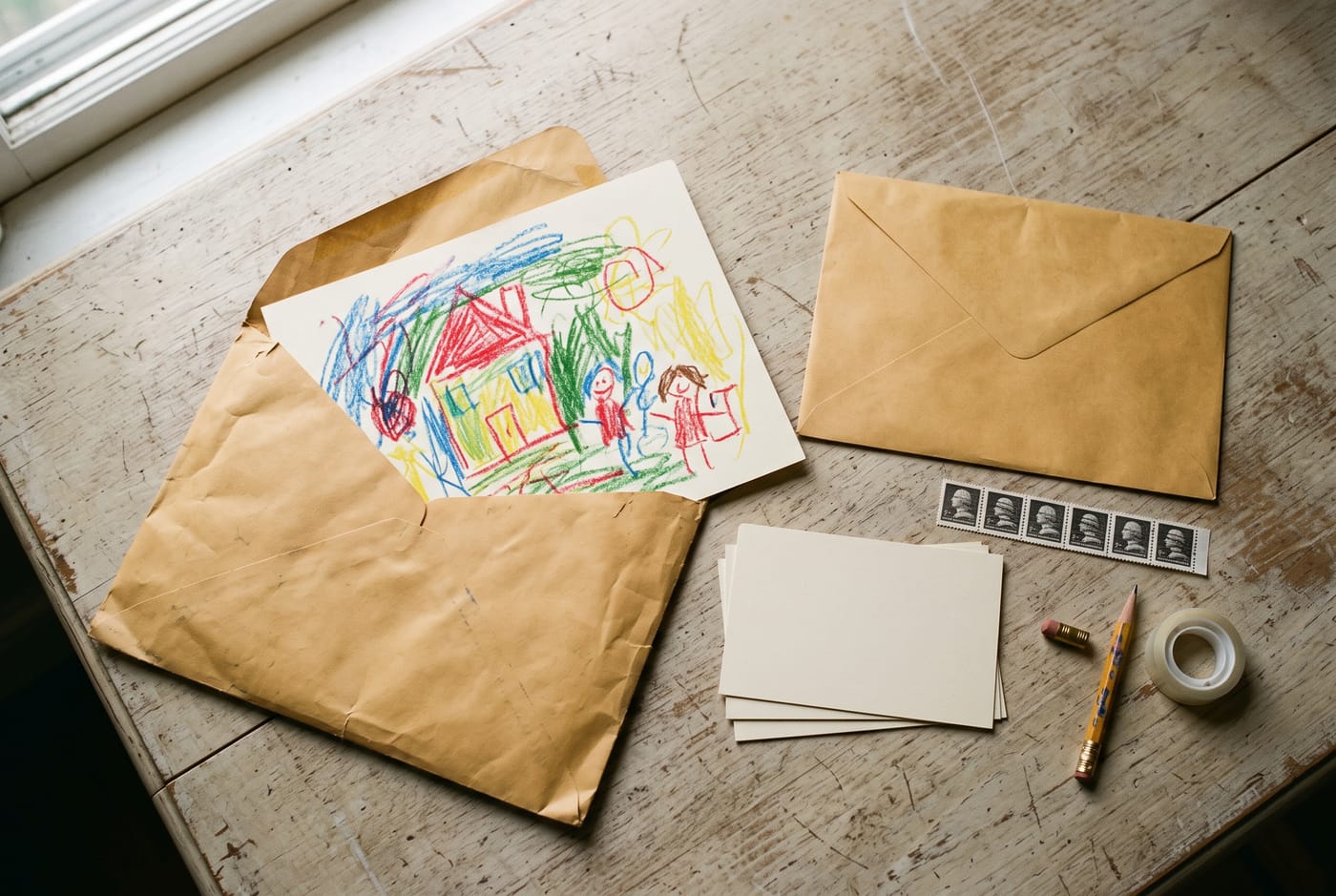
Something small travels one way, something small travels back. A drawing out, a postcard in. A pressed leaf out, a sticker in. What turned this from a nice idea into a ritual is one rule: whatever arrives gets answered — not well, not on time, just answered. The loop is the thing, not the contents.
Number them if you want the child to feel the thread. Ours are numbered in pencil in the corner, and a four-year-old who cannot read can still tell the number is getting bigger, which is a surprisingly powerful thing to hand somebody. Mail also has an advantage no call has: it is still there on Wednesday, on the fridge, doing the work all week while everybody is busy.
Sending beautiful things and waiting for beautiful things back. A scribble returned this week beats a masterpiece returned next month. Once either end starts apologising for what they sent, the loop is already closing.
The frame nobody has to operate
A digital photo frame on the far-away counter, filled from the parents’ phones. It earns its place where the shared album did not because it removes the step where somebody has to go and look. Nobody opens an app to check on their grandchildren. Nobody has to open a picture frame. It is simply on, in the room they are already in, working while the kettle boils.
It also solves the thing nobody says out loud: the far-away grandparent misses the ordinary, not the milestones. They get sent the first day of school. What they want is the Tuesday — the terrible haircut, the sandwich, the dog looking guilty. Send the boring ones. The boring ones are the relationship.
Treating it as an archive. Twelve unconsidered photographs a week beat a curated hundred at Christmas, and a frame showing the same forty pictures since March has stopped being a window and gone back to being an ornament.
The narrated ordinary
The child gives a tour. The bedroom, the garden, the new shoes, the inside of the fridge. The adult’s job is to be carried around and ask small real questions. Five minutes, no agenda, and it is the only format here where the child is unambiguously in charge — which is why they will tolerate it long after they have stopped tolerating being interviewed.
The grandparent’s version runs the same way in reverse, and it matters more than it sounds like it should. Show them the kitchen, what you are cooking, the weather out the back door. Children build their sense of a person out of that person’s room, and a grandparent who exists only as a face in a rectangle is far harder to hold onto than one with a kitchen in it.
Length. This is a five-minute format pretending to be nothing at all. Give it a start time and a duration and it becomes the weekly call again — and then it dies on exactly the schedule above.
Four things we tried and quietly stopped
Call whenever you can
The worst of the lot, and the one nearly everybody starts with because it sounds generous. An open invitation is an obligation with no edges. Both ends wait to be the one who is not interrupting, both feel faintly guilty, and the weeks stack up. A fixed slot that sometimes gets missed beats a standing offer nobody wants to use first.
The nightly bedtime story
Beautiful for eleven days. It needs two households calm at the same moment every evening, which is not a thing that happens, and the first missed night makes the second easier to miss. Weekly is a rhythm. Daily is a test somebody is going to fail — and the failing is what leaves the mark.
The long letter
I wanted this one to work more than any of the others. But a letter written to be kept takes an hour nobody has, and a child under about nine cannot answer it, so the loop never closes and the writer slowly works out they are posting into a void. A postcard nobody laboured over comes back. A letter somebody laboured over does not.
The watch-along
Two screens, same film, everyone together-ish. What happens is two households watching separately with a small awkward window in the corner, and a child who wants to watch the film. Shared attention needs something to point at that is not itself a screen.
Five minutes is a ritual. Forty is an event.
I know the instinct, because I have it too. You do not get much, so when you get some you want to make it count, and you stretch it. Then the child goes floppy at minute twelve and you come away thinking they have gone off you. They have not gone off you. You booked a meeting with a six-year-old.
Keep it short, keep it the same, let it be boring. Boring is the goal. You are not trying to be the highlight of their week — you are trying to be a fixed thing in it, like Tuesday, like the dog. That is what a grandparent down the road gets for free, built out of a hundred unremarkable five-minute appearances rather than four unforgettable afternoons a year.
And ask for the ordinary specifically, because nobody will think to send it. My mother wrote to me about her garden for twenty years. I could not tell you one interesting thing she said about it, and I can still see the garden.
Three of the four rituals above cost nothing but a book, a stamp and a habit. The fourth is the only place I would spend money, and I would spend it on a digital photo frame the far-away grandparent never has to operate — the kind the family fills from their phones, that wakes up on somebody’s counter and simply carries on. Look for one a parent can send to without an account being set up at the other end, and put it where they already stand rather than where a picture frame is supposed to go.
Digital photo frames that fill from a phoneSome links on this page are affiliate links — if you buy through one, HowTo: Family Edition earns a commission at no extra cost to you.
Two things worth saying plainly. The parents set the terms, every time. Photographs of somebody’s children are theirs to share or not, a frame in a grandparent’s kitchen is still a screen showing a child’s face, and a call landing in a bad afternoon should be moved without anybody taking it personally. Ask first, ask again occasionally, and let a no be a no. The grandparents who get the most access are reliably the ones easiest to say no to.
And a child who does not want to be on the call is not a verdict on anybody. Four-year-olds are shy in bursts, seven-year-olds are busy, eleven-year-olds go quiet for a year and come back. Let them wave and go. The ritual holds perfectly well with one end doing all the talking for a while. I am a grandmother with a stack of envelopes and a long memory, not a child development professional — anything that genuinely worries you about a child belongs with somebody qualified.
Pick one. Put it on the same day. Keep it short enough that nobody has to be in the mood for it. The distance was never the problem — the empty half hour was.
Rebecca
September 2026
More from Rebecca →