A game night does not fall apart because the game was bad. It falls apart because somebody at the table already knows how it ends.
Our table on a Sunday is a five-year-old, an eleven-year-old, my two grown children and whoever they married, and me at the end with the tea. That is a ten-year gap between the two smallest people and about fifty between the smallest and the largest, and for a long time I treated it as an evening to be got through rather than a problem with a solution.
I ran game nights in the eighties out of a shoebox of battered cardboard. I run them now out of a shoebox of battered cardboard with a tablet propped against the fruit bowl so a cousin in Ohio can play too. Different century, identical failure. The little one goes quiet around minute twenty, then goes floppy, then goes to the sofa, and the rest of us play on with the specific cheerfulness of people pretending nothing happened.
What I eventually worked out is that a five-year-old can absolutely lose. Losing is fine. What a five-year-old cannot do is lose slowly, in public, for forty minutes, while everyone watches it coming. That is the gap. And the gap is fixable — not by finding a magic game, but by handing out an advantage before the first turn and then playing the thing honestly.
By Rebecca · Parenting · September 2026
Four ways a mixed-age game night actually dies
The long tail
The winner is settled somewhere around minute ten and the game keeps going until minute fifty. Grown-ups can sit inside a foregone conclusion and stay pleasant about it. A small child experiences it as forty minutes of being told, repeatedly, that they are losing.
Play games that finish at the moment somebody wins. If the ending has a long walk attached to it, that game belongs to a different evening.
The reading wall
Nothing is wrong with the game except that every card carries three sentences on it, and one player at the table is still working out the difference between b and d. They are not bored. They are locked out, and children handle being locked out by wandering off.
Read every card aloud, for everybody, all night. Not just the young one’s — the moment it is only their cards being read out, it stops being how the table plays and becomes a thing being done for them.
The waiting
Six players, strict turn order, and the youngest waits eight minutes to do four seconds of something. No five-year-old on this earth has eight minutes of waiting in them, and the ones who appear to are usually just quietly leaving.
Favour games where everyone moves at once, or give the waiting a job — roller, dealer, timekeeper, scorekeeper. A job is not a consolation prize. It is a reason to stay at the table.
The quiet rescue
Somebody takes an obviously bad turn so the little one can get ahead. It is done kindly and it is spotted immediately — children are far better at reading a room than we credit them for. What they take from it is not I won. It is they don’t think I can really play.
Everything below. Do the helping out loud, in advance, with the whole table’s agreement — then play like you mean it.
Three of those four are logistics and you can solve them by picking differently. The fourth is the one that matters, and it is the only one that requires anybody to change how they behave.
Hand out the handicap, then play properly
The youngest plays with their cards face up, and anybody may advise. They still choose. They just choose with the table’s help, out in the open.
My addition, learned the hard way: I play mine face up too. Then it is how two of us are playing tonight, rather than an arrangement made for the baby.
One seat, one set of pieces, two people. The small one decides and the grown-up moves. This is the one that rescues games otherwise far too old for the table.
Rotate who is paired with whom every game. Being permanently somebody’s passenger is its own quiet message, and they get it.
They begin ahead. Extra pieces, extra points, a shorter distance to travel, one free go held in reserve for later.
Set the size of it together before the first turn. Getting it wrong is fine and normal — you adjust it next week, in front of everyone, like tuning an instrument.
Announced in advance, it is a handicap. Applied quietly mid-game, it is charity.
That is the entire difference, and children can tell the two apart from across a room. A handicap agreed out loud by everybody at the table is a rule of tonight’s game, which means a win that comes after it is a real win they get to keep. A grown-up throwing a turn at minute thirty is a secret being kept about them, and they will work out what the secret is. Say the number, agree it, write it at the top of the score sheet if there is one, and then go at each other honestly — the honesty is the part they are actually here for.
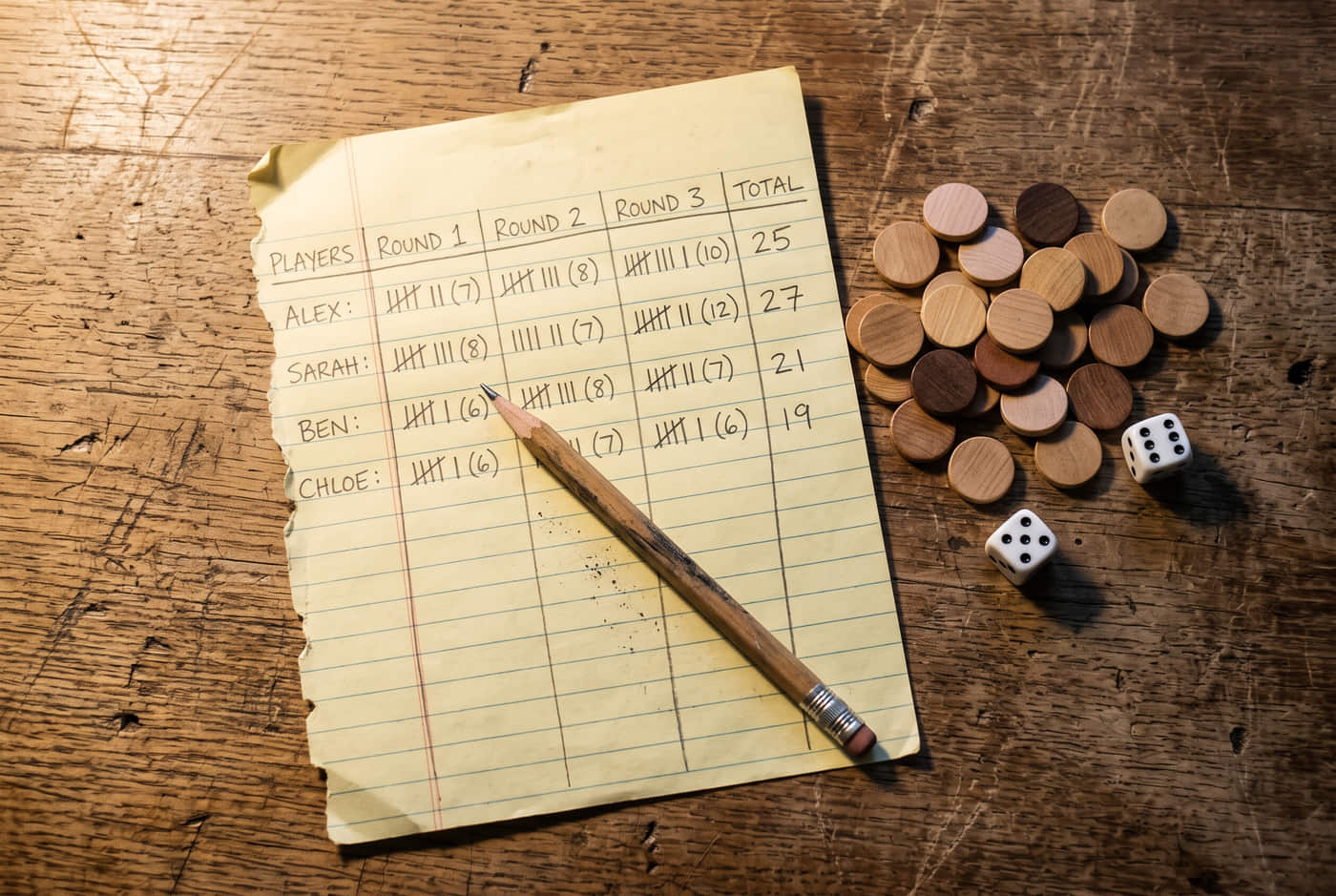
Four tests a game has to pass to survive a wide table
That last one is the single most useful thing I have learned in fifty years of this, and it did not exist when my two were small. A game the whole family loses or wins together does not care how old anyone is. Nobody has to be handicapped, because nobody is being beaten — and the five-year-old who spots the thing the adults missed becomes, for one glorious minute, the most important person in the room.
Three sentences for the parts that go sideways
Somebody is going to lose badly, somebody is going to be kind in the wrong way, and at some point the evening is going to turn. None of that is a failure. It is just Sunday. These are the three things I keep in my pocket, and all three are short on purpose — the extra sentence is nearly always the mistake.
“That was close at the end.”
Only if it was. Say a true thing about the game, not a soft thing about them — then get up and put the lid on the box. Comfort makes losing into an event. Naming a fact and moving on makes it a Tuesday.
“Play properly. She’ll take a real one.”
Said quietly, to the older one, afterwards — never across the table. They are being generous with the only tool they have. You are handing them a better one.
“Let’s call it — last round.”
Ending early is allowed and it is not a failure of anything. A night that stops five minutes before it would have gone bad gets remembered as a good night, and a good night is what makes next Sunday easy to suggest.
A deck of cards and a pot of dice will carry you a very long way, and they always have. The one purchase that genuinely changes a wide table is a co-operative game — the kind where everybody plays against the board together and wins or loses as one. It is the only category that removes the gap instead of managing it, which means no handicap, no pilot, no quiet rescue, and no smallest person at the table. Look for a short playing time and a rule sheet you can teach while you deal.
Co-operative family gamesSome links on this page are affiliate links — if you buy through one, HowTo: Family Edition earns a commission at no extra cost to you.
Two things worth saying plainly. Small pieces and small children do not share a room unsupervised. Pawns, dice, coins and counters are exactly the size that causes trouble with anyone under three, and the boxes belong on a high shelf between game nights rather than in the toy cupboard. That is a supervision question, not a game question, and no age printed on a box replaces an adult being in the room.
And a child who does not want to play is not a problem to be solved. Let them deal, keep score, roll for somebody, or sit against you and watch the whole thing without joining in. Some of my grandchildren’s best game nights have been spent entirely in my lap, saying nothing. Forced fun is not fun, and an evening nobody was made to attend is the one they ask for again. I am a grandmother with a card table and a long memory, not a child development professional — anything you are genuinely worried about belongs with somebody qualified.
Pick something short, teach it in a minute, say the handicap out loud, and stop while everybody still wants one more. The game was never the point. The forty minutes were.
Rebecca
September 2026
More from Rebecca →