You cannot explain money to a child. You can only hand them some and get out of the way.
I talked at mine about money for years before I ever gave them any of it. What things cost. Why we were not buying that today. The value of a dollar, delivered in the car, at length. It went in one ear and sat there doing nothing, the way advice always does when it arrives with no bill attached.
Then we started handing over a small amount on the same day every week, and within a month my daughter knew more about the price of things than four years of me being right had managed to teach her. Not because the system was clever. Because the money was hers, and it ran out.
That is the whole trick, and it is why the systems below matter less than people think. Any of them works. What does the teaching is the moment the money is gone and the week is not, and the fact that nobody stepped in. Everything else on this page is scaffolding built around that one moment.
By Rebecca · Parenting · August 2026
Four systems, and what each one really teaches
The flat weekly
Same amount, same day, no conditions attached.
- What it teaches
- Budgeting, and almost nothing else — which is more than it sounds. The amount is a fixed frame, the wanting is not, and a child has to fit one inside the other every single week.
- Where it breaks
- Nothing is attached to effort, so a child can quietly conclude that money simply arrives. Some families never see this problem. Some see it by Thursday.
The chore wage
Paid per job, priced per job, nothing paid for nothing.
- What it teaches
- That work turns into money, which is a real and useful thing to know, and it lands faster than any of the others.
- Where it breaks
- The day they decide they would rather be broke than empty the dishwasher — and under this system, they are entitled to that trade. You built it. You cannot then be cross about it.
The hybrid
A small amount for being in the family, plus paid extras above the baseline.
- What it teaches
- Both at once. Some jobs are simply what living in a house costs and are not for sale. Others are work, and work pays. This is the one I ran, and the one I would run again.
- Where it breaks
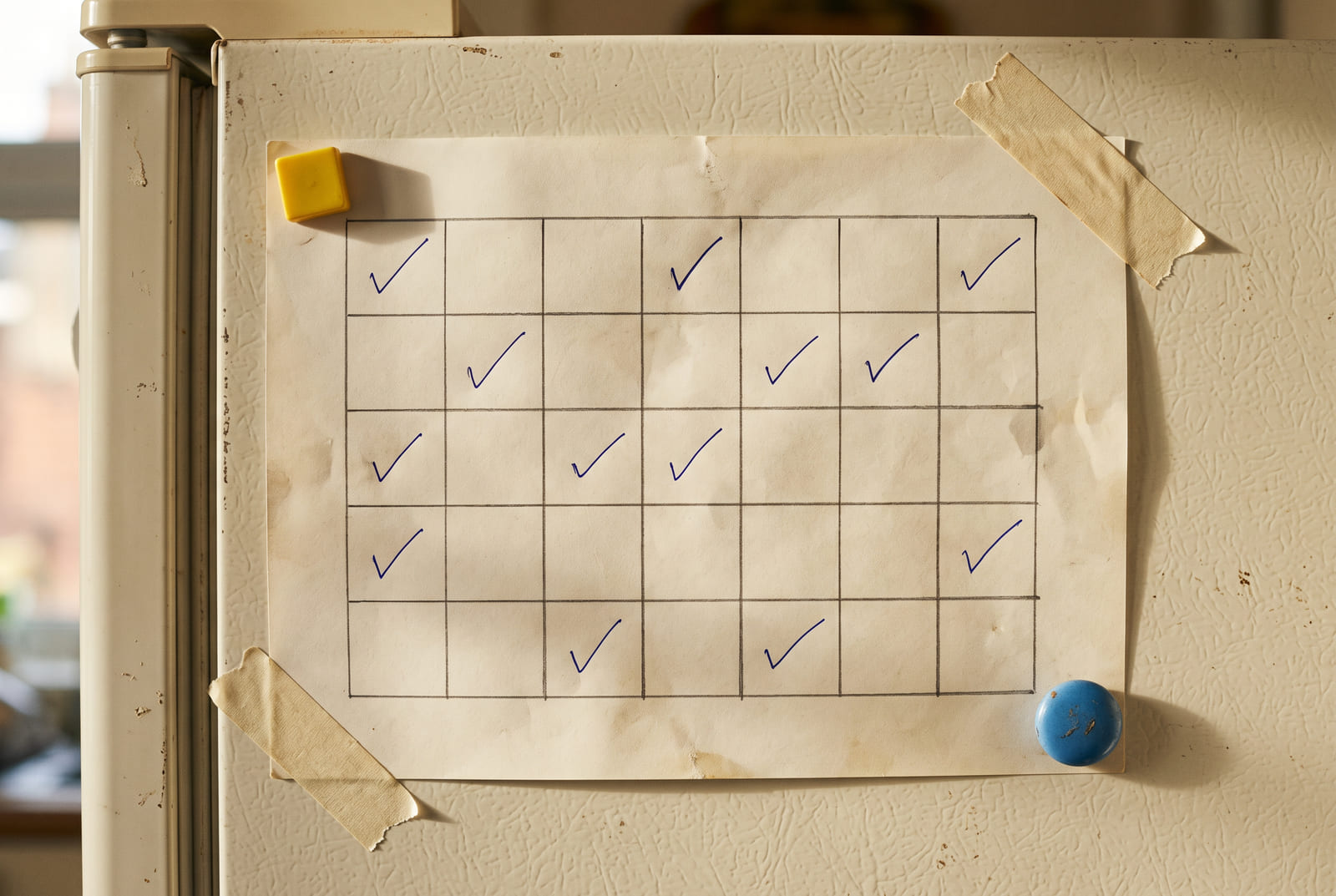
- Bookkeeping. It needs something on a wall keeping score, or it dissolves in about three weeks and everyone quietly pretends it never happened.
Ask every time
No allowance at all. Money handed over on request, case by case.
- What it teaches
- Negotiation, and to be fair, they get very good at it.
- It teaches them to negotiate with you, though — a skill they will not need after eighteen and are already better at than we are.
- Where it breaks
- There is no fixed amount, so there is no limit, so there is nothing to budget against. The thing you are trying to teach never gets a chance to happen.
Pick whichever one you can actually run for a year. A perfect system abandoned in March teaches less than a scrappy one still limping along at Christmas, and children read consistency long before they read fairness.
Three jars, and one of them is not for them
This is the one that does the teaching. It is supposed to run out. A spend jar that always has something in it is not working.
Keep it in reach and keep it in coins for as long as you can. A jar you can see the bottom of is a better teacher than any number on a screen.
Aimed at one named thing they picked — not at saving in general. Saving in general is an abstraction, and abstractions cannot compete with a jar you can spend today.
For a young child the target has to be weeks away, not months. Reaching it once is what makes the second time believable.
The smallest jar, and the first one families drop. It is also the only one that teaches money can be pointed at somebody who is not you.
Let them choose where it goes, even when the choice is sentimental or slightly ridiculous. Choosing is the part that sticks.
The split happens the second the money lands.
Not at the end of the week, not when there is something left over, not once they have had a think about it. On the table, into the jars, before it goes anywhere near a pocket. Money that is split later is never split, and a child who has already carried the whole amount upstairs has already spent it in their head. The proportions are yours to set, and they matter far less than the habit of dividing at all.
Let them buy the bad toy
My son spent a month of saving on a plastic thing that broke before we reached the car. I can still see it. Two pieces, in a parking lot, and a face I would have paid a great deal of money to undo.
Every instinct I had said talk about this. Gently. Constructively. Draw out the lesson, so that all of it counts for something. And I have watched a lot of parents since do exactly that, with the best will in the world, and undo the entire thing.
Because the toy already taught it. Completely, in one go, better than I could have. The second I start explaining what he should have done, the lesson stops being about a broken toy and becomes an argument with his mother — and he will win that argument, or lose it and resent it, and either way the toy is forgotten. The talk does not add the lesson. It replaces it.
So say nothing. It is the hardest instruction on this page and the only one that really matters. If they raise it themselves, that is different — then it is their conversation to have. Three sentences are worth keeping ready, because these moments arrive in every house.
“I’ll get it today, and it comes out of Friday.”
Then it has to actually come out of Friday. An advance you forget to collect is a gift with extra steps, and they will remember which one it was.
“That’s rough. Friday’s still Friday.”
Sympathy, and a wall. Nothing after it. The temptation to add one more sentence here is enormous and the one more sentence is always the mistake.
“It’s your money.”
Said flat, with no face. The face is what turns it into a verdict, and a verdict is a thing to rebel against rather than a decision to live with.
The job of the money changes as they grow
Money is a physical object with a limit. That is the entire curriculum. Coins and small bills, in hand, in a jar they can reach without asking. Nothing digital yet — at this age the whole point is that they can see it getting smaller.
The split starts doing real work. A named savings target they chose, close enough to reach in a few weeks. This is also the age where waiting for something and then getting it becomes a memory rather than a rule, which is worth more than the item.
Hand over one recurring cost of their own. The small one — the snack at the pool, the thing they always ask for at the store. The amount goes up to cover it and then it is theirs to manage. This is the biggest single step in the whole business, and it is the one most of us skip.
The list of what it covers grows faster than the amount does. Around here the money moves onto a card, and the teaching gets harder for a reason nobody warned me about: you cannot watch a card get thin. My grandchildren are growing up with money that has never once been a physical object. The jars mattered more than I knew at the time.
Almost nothing, again. Jars are jars, and a jam jar with tape on it works exactly as well as anything sold for the purpose. The one thing that earns its place is a chore chart, and only if you have chosen the hybrid — because the hybrid is the system that dies of bookkeeping, and a chart on the fridge is what keeps the score somewhere other than your memory. Ruled paper does the job. A printed one survives longer and settles the weekly argument about what was and was not done.
Kids’ chore chartsSome links on this page are affiliate links — if you buy through one, HowTo: Family Edition earns a commission at no extra cost to you.
Two things worth saying plainly. An allowance is a teaching tool, not a household necessity, and there are months in a lot of homes where there is nothing spare to teach with. A family that talks honestly about what this month can hold is teaching a child a great deal about money already — more, in truth, than any set of jars. If the jars are not possible right now, nothing on this page is a thing you are failing at.
And keep the money out of the discipline. Docking an allowance for a bad attitude, or an unmade bed, or a rough week at school turns it from money into a mood, and once it is a mood it teaches nothing except how you were feeling on Friday. Pay it or do not pay it, on terms you agreed out loud in advance. That is all it takes to keep it clean. I am a grandmother with opinions and a long memory, not a financial professional — anything touching accounts, taxes, or a household’s actual finances belongs with somebody qualified.
Pick a system, pick a day, hand it over, and then be quiet. The money is a better teacher than either of us. It only needs you to stop interrupting.
Rebecca
August 2026
More from Rebecca →