There are about a thousand slime recipes online and most of them say the same thing: this one always works. That is not true, and I think you already know it is not true, because you have probably made a bowl of glue soup.
So I made the five that everyone recommends, scored them the same way, and wrote down what actually happened — including the ones that went wrong, which are the useful part.
The short version: two of them are worth your afternoon. One is not really a recipe at all, it is a topping. And two of them look amazing in videos and then quietly fall apart, which is a thing nobody mentions.
By Priya · Kids · August 2026
Three tests. Same three every time.
The slow pull
Stretch it slowly with both hands. Good slime turns into a long ribbon and keeps going. Bad slime snaps almost straight away, or drips off your fingers like syrup.
The fast pull
Now yank it apart quickly. Proper slime should break with a clean snap and no strings hanging off your hands. If it webs everywhere, it is not finished.
Tomorrow
Lid on, leave it, come back the next day. This is the test that separates the two winners from the rest, and it is the one nobody bothers doing.
Five recipes, in order of worth-it
Every one of these starts with white PVA school glue. That part is not negotiable and it is the one ingredient people try to swap.
Glue + contact lens solution + baking soda
White PVA glue → a spoon of baking soda → contact lens solution, a little at a time
This is the best one, and it is the best one because it is the hardest to ruin. The solution goes in slowly, a small squeeze at a time, stirring between each one, and the mixture goes from soup to slime over about a minute. The baking soda is what makes it firm instead of sticky, so do not skip it.
The catch, and it is a big one: the contact lens solution has to have boric acid or sodium borate written on the back of the bottle. Plain saline does not have either. If you use plain saline you can stir for an hour and it will still be glue, and that is not your fault — it is the label’s fault. Check first. Passed all three tests, still slime the next day.
Glue + borax dissolved in warm water
Borax fully dissolved in warm water → added to glue in small amounts
The firmest, bounciest slime of the five, and the fastest to make. It is also the easiest one to overshoot, because borax water is strong. Add a tiny bit, stir, add a tiny bit more. The moment it stops sticking to the bowl, stop.
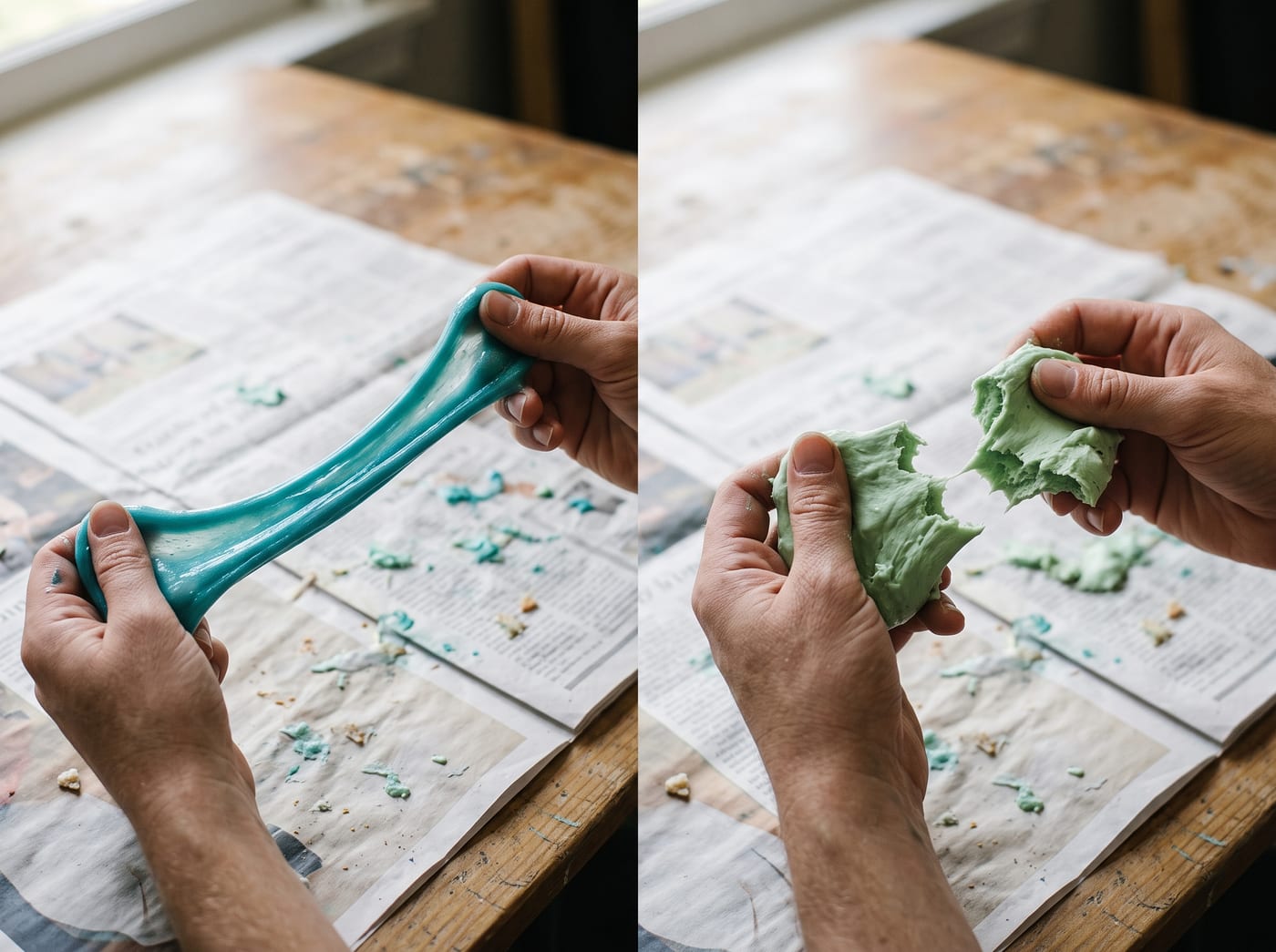
Two things go wrong here. If the borax is not completely dissolved first, you get gritty bits that never mix in. And if you pour in too much, the slime turns rubbery and tears instead of stretching — that is the right-hand picture further up, and you cannot fix it. You can only start again.
This one needs an adult, properly, not as a formality. See the note at the bottom.
Butter slime
A finished slime from recipe 01 or 02 → soft modelling clay kneaded in
Here is the thing nobody says out loud: butter slime is not a recipe. It is something you do to slime you already made. If your base slime failed, adding clay to it will not rescue it, it will just make a lumpy failed slime.
Done properly it is genuinely lovely — soft, matte, spreads like the name says. Add the clay in small pieces and knead each one in fully before the next. Add too much and it stops stretching and starts crumbling, which happened to mine. It also dries out faster than plain slime, so the lid matters more.
Worth doing if you already have a good batch. Not worth starting your afternoon with.
Cloud slime
A finished slime → instant snow powder, hydrated with water first
Instant snow is a powder that drinks water and puffs up. That is the entire trick, and it is also the entire problem. If you tip the powder in dry, it does not sit there politely — it pulls the water out of your slime, and your good stretchy slime turns crumbly and sad in front of you. Mine did.
Even when you soak the snow properly first, the famous drizzly cloud texture does not last. It dries out quickly and by the next day it was stiff and flaky. It failed the tomorrow test badly.
Fun for about twenty minutes. Not worth what it does to a batch of slime that was working fine.
Fluffy slime with shaving foam
Glue → a big pile of shaving foam → activator
This is the one from all the videos, and honestly, making it is great. It puffs up enormous, it is light, it squishes with a noise. For about an hour it is the best thing on the table.
Then it deflates. Shaving foam is mostly air held in bubbles, and bubbles pop. As they do, all that volume disappears and you are left with ordinary slime — less of it than you started with, and often stickier. By the next morning mine had shrunk to a small flat blob with no fluff left at all.
It is a good thing to make and a bad thing to keep. If you are making slime for a party, make this one. If you want slime that exists on Thursday, do not.
Slime is glue with a few knots tied in it
Glue is made of really long molecules, all lying next to each other and sliding around. That is why glue pours. The activator — the boric acid, the sodium borate, the borax — does one job: it ties those long molecules together in places.
A few knots and you get slime. The strands can still slide, but not away from each other, so it stretches instead of pouring. Too many knots and you get rubber, because nothing can slide at all, so it snaps. No knots and you get glue soup, which is what happens with the wrong contact solution.
That is the whole thing. Every single failure on this page is one of those three, and once you know which one you are looking at, you know whether to add a drop more or start again. Rubbery means start again. There is no undo.
Four things. Not fifteen.
White PVA school glue. Baking soda. Contact lens solution with boric acid or sodium borate on the label. A bowl and something to stir with. Food colouring if you want, but colour does nothing to whether it works — I checked, because I thought it might.
You can buy all of that separately for less, and if you already have glue in the house you should. The reason I would get a kit instead is that the activator in a proper slime kit is meant for slime, so you are not standing in a shop reading the back of a bottle trying to work out whether it counts. That is the one part beginners get wrong, and a kit removes it.
Slime making kitsSome links on this page are affiliate links — if you buy through one, HowTo: Family Edition earns a commission at no extra cost to you.
The argument you are about to have
It is chemistry and it is mine.
I mixed it, I measured it, I worked out why the green one failed. That is a real experiment even though it is also a toy, and I would like it to be allowed to exist in a container in this house.
It gets on everything, and they are right.
Slime does come out of hair and off tables, but it is genuinely miserable on carpet and on fabric sofas, and someone always ends up doing that job. Pretending otherwise is how you lose the argument.
Paper down first, kitchen table only, and I clean it up — not later, straight after.
Plus: it lives in a container with a lid, and it never goes near the carpet or anything soft. Offer that up front, before anyone asks, and you will get a yes. I have found that offering the rule before you are given it works on almost everything, which is annoying but true.
Borax and slime activators are not toys, even though slime is. An adult should handle the borax powder and mix the borax water — not standing nearby, actually doing that part. Do not breathe in the powder, and keep the container away from little kids and pets.
For all five: nobody eats any of it, hands get washed properly afterwards, and it stays away from eyes. If your skin goes red, itchy or sore, stop and wash it off — some people react to activators, and if you already have eczema or a cut on your hand, sit that one out or wear gloves. If any gets in an eye, rinse with water and tell an adult straight away.
And none of this is for toddlers or anyone who still puts things in their mouth, no matter how much they want to. I am a kid who likes chemistry, not a chemist — if you are not sure about a product or someone has swallowed something or reacted to it, that is a grown-up and a doctor, not a website.
Make recipe one. Check the back of the bottle before you start. Then make recipe two when you want something bouncier, and skip the two that deflate.
If you have never made any of them, start with the plain step-by-step I wrote first. It is recipe one, slower, with the bits people get stuck on.
Priya
August 2026
More from Priya →